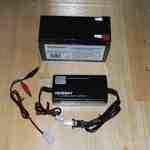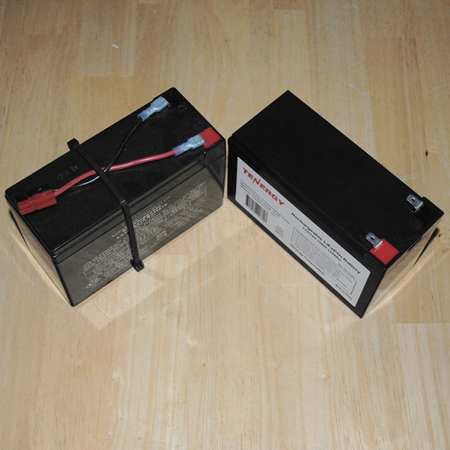
I measured the mass of each battery.
On the left is the typical 7AH 12V (~84 WHrs) battery with mass of 2.252 kg (4 lbs 15.4 oz.).
On the right is the new 10 AH 12V (~120 WHrs) battery with mass of 1.190 kg (2 lbs 10 oz.).
Assuming a typical voltage of 12 volts and taking the label battery capacity at face value we have:
Specific energy of the lead-acid battery is ~38 WHrs/kg or 134 kJ/kg.
Specific energy of the LiFePO4 battery is ~101 WHrs/kg or 363 kJ/kg.
The Lithium’s specific energy is about 2.7 times the lead-acid.
This is quite an improvement.
Both batteries occupy the same volume so the Energy Density improvement is 120 WHrs/84 WHrs = 1.5 or about 50% more energy for the volume it consumes in your backpack. This is an improvement, but not as noteworthy as the specific energy.
Of course much depends on the actual voltage and how much charge you can really pull out of each battery.